
Food brands, fresh-produce exporters, central kitchens, and retailers are under growing pressure to improve packaging decisions without creating new operational or compliance risks. At the same time, buyers still need film that performs in real use: it must cling, stretch, protect food, run on packaging equipment, and arrive at a workable landed cost. That is why the discussion is no longer simply “plastic or no plastic.” The practical question is which film structure best fits product type, shelf-life target, disposal reality, and market claims. In that context, compostable cling film has become a serious procurement topic rather than a niche concept.
Global plastics use remains substantial. UNEP estimates that more than 400 million tonnes of plastic are produced globally each year, with a substantial share used in short-lived or single-use applications. OECD has also reported that global plastic waste reached 353 million tonnes in 2019, while only 9% was recycled. Those numbers help explain why food-packaging teams are re-evaluating short-life applications such as wraps, produce protection, and food-service packaging. However, buyers still need to move beyond slogans. A compostable film may offer a better end-of-life pathway in some settings, but it still has to be tested against performance, regulations, and the local disposal system.
This guide compares compostable cling film and conventional cling film in plain commercial terms. It explains how the materials differ, what each one can and cannot do, how food-contact compliance should be documented, and how end-of-life options should be judged. It also clarifies where SYNLIFE® and ZeRoll® fit into a professional sourcing workflow for brands that want better evidence before they switch.
Compostable cling film is a flexible packaging film designed to provide wrapping performance while also being developed for biodegradation under specified composting conditions, whereas conventional cling film is typically based on persistent plastic chemistries optimized mainly for packaging performance and processing efficiency.
The first distinction buyers should make is structural and not purely marketing-based. Conventional cling film is commonly made from PVC, polyethylene (such as LDPE/LLDPE), or other established polymer systems chosen for excellent stretch, cling, puncture resistance, and cost control. These materials are familiar to converters, distributors, and end users because they run well, have stable supply chains, and are widely understood in food-service operations.
Compostable cling film, by contrast, is typically formulated from biodegradable polymer systems. Those formulations may include renewable and non-renewable inputs depending on the product grade and the intended functionality. A compostable grade should not be assumed to be identical to conventional wrap in processing, shelf stability, or disposal. It also should not be assumed to degrade in every environment. Compostability is claim-specific and must be tied to a named standard, a test method, and a disposal context.
For B2B buyers, the difference is practical: conventional film is usually the benchmark for performance and cost, while compostable film is evaluated as a performance-and-disposal package. That means purchasing teams should compare more than price per roll. They should compare the total outcome, including failure rates, seal performance where relevant, film breakage, operator acceptance, label risk, waste sorting, and the strength of the supplier’s documentation.
Compostable cling film materials are biodegradable polymer systems engineered to deliver cling, flexibility, and wrapping function, while conventional cling film materials are long-established packaging polymers selected primarily for processing consistency, optical performance, and cost efficiency.
In the market, “compostable cling film” may cover several material approaches. Some grades focus on produce wrapping and short contact time. Others are developed for broader food-service use, including tray covering, catering, or kitchen workflows. Film composition, additives, thickness, and conversion quality all affect how the material behaves. A buyer therefore needs the exact product grade, not just a category name.
Conventional films often have the advantage of mature machine compatibility and highly optimized converting parameters. Compostable films may require closer attention to storage conditions, roll tension, pre-stretch behavior, tear direction, and application temperature. In some applications, the difference is minor; in others, it affects operator handling and waste rates. This is one reason why product trials should be conducted on the intended equipment and with the intended food item rather than in abstract lab terms only.
Where brands are exploring broader materials strategy, it can also be useful to understand the upstream resin platform. SYNLIFE® connects finished applications such as ZeRoll® with a wider bio based resin development capability through YOGTIC®. That matters because film performance does not start at the roll level; it starts with the formulation, conversion behavior, and the supplier’s ability to align raw materials with the final application.
Typical household and food-service wraps often fall within thin-gauge ranges, but thickness alone does not predict performance. Household cling films are generally thin-gauge films, but thickness alone does not determine performance. Buyers should compare the full structure, not just gauge, because formula, orientation, and manufacturing quality all influence how the film behaves in practice.
Compostable cling film vs conventional cling film is fundamentally a performance comparison between two packaging approaches that may serve similar end uses but often reach those results through different material behavior, processing windows, and handling characteristics.
In fresh-food wrapping, the main concerns are usually cling, stretch, puncture resistance, tear behavior, transparency, anti-fog behavior where relevant, and the impact of the film on shelf appearance. Conventional cling film often performs strongly across these benchmarks because decades of industrial optimization have reduced variation. Buyers know how operators will handle it, how it dispenses, and how it behaves under refrigerated retail use.
Compostable cling film has improved significantly, but the right question is not whether it is “better” or “worse” in the abstract. The right question is whether it is fit for a specific use case. For example, a deli application with long hold times, high moisture, and frequent manual handling may require different performance from a short-cycle produce-wrapping operation. In some use cases, the switch can be straightforward. In others, the buyer may need to accept trade-offs or request a customized grade.
Performance evaluation should include both lab and line tests. Useful tests include puncture resistance, elongation at break, tear propagation, optical haze, water-vapor transmission, and practical wrap retention around trays or bowls. A good supplier should help define pass/fail criteria before testing starts. Otherwise, the customer may receive positive-sounding sample feedback that does not translate into scalable production performance.
When discussing commercial transitions, it is often helpful to anchor internal decision-making around a working specification for compostable cling film rather than around general sustainability claims. That keeps engineering, procurement, and marketing aligned on the actual performance target.
Compostable cling film and food-contact compliance requirements refer to the legal and technical documentation needed to show that a film is suitable for contact with food under stated conditions of use and that its environmental claims do not replace the need for packaging-safety evidence.
This is one of the most important sections for procurement teams because sustainability positioning does not override food-packaging rules. A film intended to contact food must be supported by the applicable compliance framework for the destination market. Buyers typically request a declaration of compliance, migration-related information where relevant, substance statements, technical data, and clarity on contact conditions such as fatty foods, refrigerated storage, and heating restrictions.
For U.S.-bound projects, teams usually review FDA-related suitability. In the EU and other markets, customers may also request declarations aligned with local food-contact frameworks, testing reports, or supporting statements from accredited laboratories. The exact package depends on the destination market, the food category, and the packaging format. A supplier should be able to explain not just what documents they have, but what each document does and does not prove.
Compostability claims also need their own evidence. A film may be suitable for food contact and still require separate compostability support. Procurement teams should therefore ask for two parallel evidence streams: one for food-packaging suitability and one for end-of-life claims. Mixing those categories in supplier communication creates risk. The cleanest process is to maintain a packaging-compliance file and a disposal-claim file separately.
SYNLIFE® positions ZeRoll® as a biodegradable and compostable cling film for food-wrapping applications. That phrasing matters because it avoids overstating the claim. It also gives buyers a more realistic starting point for requesting grade-specific compliance and testing documents before launch.
Compostable cling film end-of-life options are the real-world pathways available after use, including home composting, industrial composting, and residual waste, and they determine whether a compostability claim is likely to create practical value or just messaging complexity.
Many procurement errors happen because buyers treat end-of-life as a theoretical issue. In reality, disposal conditions shape the value of the packaging decision. A film intended for industrial composting may require controlled temperatures, oxygen availability, moisture, and processing conditions that are very different from home compost. Standardized industrial compostability testing commonly uses controlled thermophilic conditions, often around 58°C, while household composting is lower-temperature, less consistent, and slower.
That means the customer must match the claim to the disposal reality. If the target market has limited organic-waste collection or no industrial composting infrastructure, a compostable film may still be technically interesting but operationally difficult. On the other hand, in a controlled closed-loop setting such as food service with organized organic-waste collection, the claim may be more meaningful.
Residual waste is also a relevant scenario. If a used film is contaminated with food and the disposal route remains mixed waste, the packaging team should not assume the environmental outcome automatically improves. The role of the supplier is therefore not only to offer a film, but to help the buyer define the likely disposal path honestly. That is often more valuable than making an aggressive front-of-pack claim.
A food packaging film supplier should be involved early when film performance, food-contact evidence, and disposal claims all influence the packaging design, because late supplier engagement usually increases risk, delays validation, and weakens commercial decision-making.
Many brands first compare price and only later ask technical questions. That sequence is inefficient. For compostable applications, the better workflow is to involve the supplier once the product brief is defined. The brief should include food type, storage condition, wrapping method, target shelf-life, market destination, annual volume, and the intended claim boundary. With that information, the supplier can recommend a relevant grade and testing pathway.
This is also where supplier type matters. A converter selling standard stock rolls may not offer the same guidance as a development-oriented partner. Buyers looking for a broader bio based materials strategy may benefit from a partner that can connect film products, resin knowledge, and project-level guidance rather than simply shipping packaging inventory.
Early involvement also helps quantify business risk. If film scrap rates rise by 2% or line speed drops by 8%, the switch may still be viable—but only if the buyer has modeled the change. The supplier should help define these checkpoints before scale-up, not after complaints begin.
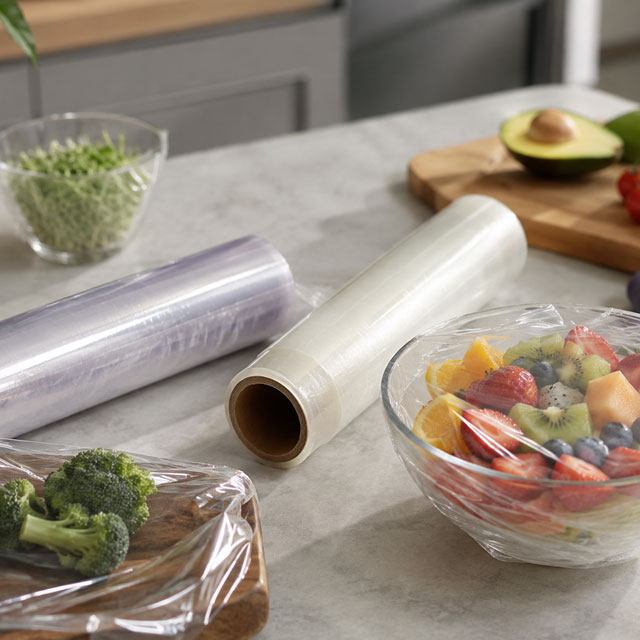
Cost, risk, and supply planning for compostable cling film means comparing not only price per kilogram or roll, but also the broader commercial variables that determine whether the material can be scaled with consistent quality and acceptable total cost of ownership.
Conventional films usually benefit from large global supply systems and lower relative volatility. Compostable films may have narrower supplier bases, more specialized raw-material streams, and different minimum order quantities. Some buyers can absorb that with planned procurement; others cannot. The answer depends on annual volume, market positioning, and how critical the claim is to the product strategy.
The most useful commercial comparison includes at least seven points: ex-works price, conversion yield, lead time, MOQ, shelf stability, documentation quality, and sample-to-production consistency. Packaging teams should also ask about change control. If the supplier modifies raw materials, additives, or processing aids, how will the customer be informed? That question is especially important when the claim itself is part of the product promise.
Some buyers also overlook training cost. If a film dispenses differently or requires slightly different operator handling, that training should be budgeted. In high-volume food packaging, small operational frictions create large cumulative cost differences over time.
The comparison table below summarizes the most important commercial differences between compostable cling film and conventional cling film so that packaging teams can align technical, sourcing, and claim decisions before they move into mass purchase.
| Comparison Area | Compostable Cling Film | Conventional Cling Film | Buyer Implication |
|---|---|---|---|
| Primary purpose | Food wrapping with a claim-linked end-of-life pathway under specified conditions | Food wrapping optimized mainly for packaging performance and cost | Define whether disposal outcome is a real project requirement |
| Material system | Biodegradable polymer formulation, grade-specific | PVC, LDPE, or similar established film structures | Ask for exact formulation and grade positioning |
| Food-contact evidence | Required, separate from compostability evidence | Required, often mature and standardized in supply chains | Keep safety and environmental files separate |
| Cling and handling | Can be suitable, but must be validated in the target use case | Usually well understood with long commercial history | Run line trials with pass/fail criteria |
| End-of-life pathway | Depends on home or industrial compost conditions and local disposal reality | Typically residual waste; recycling is limited in contaminated short-life use | Infrastructure determines practical value |
| Supply maturity | Developing, narrower supply base in some regions | Highly mature and globally available | Review MOQ, lead time, and continuity |
| Cost profile | Often higher unit cost, depending on grade and order size | Usually lower and more stable | Model total cost, not price only |
| Claim risk | High if claims are broad, vague, or infrastructure is weak | Lower claim complexity, but higher sustainability pressure | Use precise language tied to evidence |
SYNLIFE® and ZeRoll® support compostable cling film projects by connecting application understanding, material-development capability, and B2B documentation workflows so that buyers can move from general interest to a more defensible project decision.
From a buyer’s perspective, one of the most valuable things a supplier can do is define the project clearly. SYNLIFE® can work with product developers, brand owners, importers, and retailers that need a structured review of application requirements instead of a broad sustainability story. ZeRoll® is positioned as the application-facing cling-film line, while YOGTIC® represents the broader materials capability behind bio-based and biodegradable resin development.
In a practical workflow, the buyer provides the packaging use case, target market, estimated consumption volume, food type, equipment details, and claim boundary. The supplier then helps narrow the recommendation, prepare a sample plan, and define which documents should be reviewed before any public claim is made. This approach is especially useful for food brands that need a food packaging film supplier capable of supporting testing, not only shipment.
For commercial teams, that kind of structure shortens internal decision cycles. Procurement gets clearer quotations, quality teams get a cleaner document set, and marketing gets better guidance on what can be said safely and accurately.
Compostable cling film and conventional cling film should be compared through the lens of fit, not ideology. Conventional film remains the established benchmark for cost efficiency and predictable handling. Compostable cling film can offer a relevant alternative when brands have a credible disposal pathway, a realistic claim strategy, and a supplier that can support validation.
The best procurement outcome comes from aligning four elements: application performance, food-contact compliance, end-of-life evidence, and commercial scalability. If one of those four is weak, the project becomes vulnerable. If all four are defined well, the packaging team can make a more confident decision and explain it clearly to internal stakeholders and customers.
For brands exploring a more structured packaging transition, SYNLIFE® and ZeRoll® can provide a grounded starting point: test the actual application, review the actual documents, and define the actual claim boundary before scaling.
1. Is compostable cling film always biodegradable in home compost?
No. Compostable cling film is not automatically suitable for home compost. Some grades are intended for industrial composting conditions and need controlled heat, oxygen, and moisture. Buyers should request the specific standard, test scope, and intended disposal route.
2. Can compostable cling film be used for all foods?
Not automatically. Suitability depends on the food type, contact condition, storage temperature, and the film’s documented compliance position. A supplier should provide food-contact information that matches the intended use.
3. Does compostable cling film perform exactly like conventional cling film?
Sometimes it can be close, but performance should never be assumed to be identical. Cling, tear behavior, stretch, and handling can vary by grade. Real application trials are essential.
4. Why should buyers separate food-contact documents from compostability documents?
Because the two prove different things. Food-contact documents relate to packaging safety and legal suitability, while compostability documents relate to end-of-life behavior under stated conditions. One does not replace the other.
5. Is compostable cling film always the more sustainable choice?
Not in every situation. The more appropriate choice depends on the application, the disposal infrastructure, the supplier’s evidence, and the customer’s actual waste pathway. A technically compostable film does not deliver the same value in every market.
6. What should a buyer ask first when evaluating a compostable cling film supplier?
Start with the exact application, destination market, food type, target shelf-life, expected volume, and desired claim boundary. Then ask for a recommended grade, test plan, food-contact documentation, and evidence supporting the disposal claim.